redvypr

redvypr stands for: Realtime data viewer and processor (in Python)
Introduction
Sampling data does always require the similar tasks.
Reading data from sensors
Saving the data
Processing the raw data into meaningful units
- Adding metainformation to the dataset, for example:
time
location
experiment
responsible person(s)
project …
Plotting data for a quicklook
Do a first dataanalysis
Before the development of digital sensors these tasks have been performed mainly by reading scales and documenting the data onto paper. By the still continuing digitalisation of sensors, the number of sensors and the amount of data output is increasing drastically, which creates challenges in performing the above mentioned tasks, especially if several sensor need to be fusioned, as they provide data at transferred via different physical interfaces, different frequencies, times and data formats:
Digital sensors have an non overseeable amount of interfaces like UART, SPI, I2C, ethernet, to name a few, and their own data format. Sensors are generally shipped with their own software for sampling. The complexity starts if a user wants to fuse data from several sensors in realtime. An often used approach is to merge the data after the measurement. The data is typically located in several files with different data formats. The users needs to read each data format containing most likely different time stamps and data with the complex task to synchronize the data and create a usable dataset.
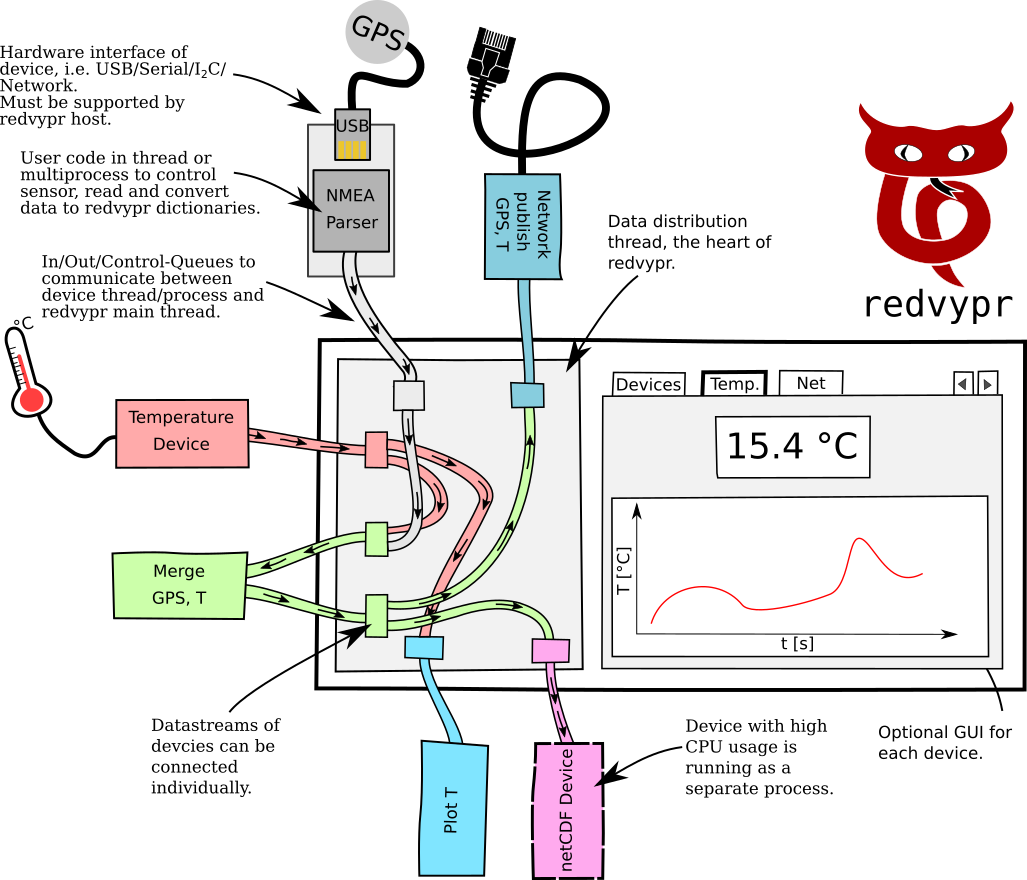
Redvypr is a tool to help to work with digital sensors by providing a python based infrastructure allowing to add sensors, interconnect sensors, process and save the data gathered by the sensors. Python is choosen as the language as it provides a rich infrastructure of packets to deal with digital data and its interfaces, i.e. using network devices, databases or serial connections. The extensive usage of threads and multiprocesses allows to work with data received from various sensors at different times and frequencies (asynchrone).
Redvypr was designed with the following goals in mind: - Runs on small embedded systems - Allows to work with asynchronously received data from multiple sensors - Scalable by using several redvypr instances either on one computer or on a network - Can be easily extended by users - Setup via a configuration file and an optional GUI
What does it provide?
Redvypr provides the infrastructure to distribute, save, display and plot digital datastreams produced by sensors. New sensors can be integrated by creating an own device, example devices are provided with redvypr. By solely using python it gives the user the flexibility to use the almost infinite number of python packages to read and process their data.
Each devices runs in an own thread or an own process, which allows to do multiprocessing. Time or computationally intensive tasks are not blocking the whole process, an example is the netCDF logger, that can write on-the-fly compressed data provided by different sensors (GPS example).
What it is not?
Redvypr provides the infrastructure for sensor but does not provide out of the box interfaces to the almost infinite number of different sensor realizations. The user needs to write their own interface using the API provided by redvypr. Since redvypr is written in python it is not well designed for “fast” sensors, i.e. sensors with sampling rates well above 100 Hz and need to be processed at the same frequency. Despite this, redvypr is principally capable to buffer the data and transport larger packets, avoiding a data loss. This data can then be processed on lower frequencies by downstream devices.